
- Home
- Walk-In Clinic
- Kidneys
- Men’s Health
- Bladder
- Bowel
- Patient Info
- Team
- Contact
- Our Locations
- Records
Kidney cysts are fluid-filled sacs that develop within or on the surface of one or both kidneys. They are common, especially as people age, and are often discovered during imaging tests performed for unrelated medical concerns.
Most kidney cysts are simple cysts, meaning they have thin walls, contain fluid, and are generally harmless. These cysts typically do not affect kidney function or require treatment.
However, some cysts have more complex features, such as thicker walls, internal divisions, or solid components. These complex kidney cysts may require additional imaging or monitoring to determine whether further treatment is necessary.
The size, appearance, and characteristics of a kidney cyst help your urologist determine the most appropriate course of care.
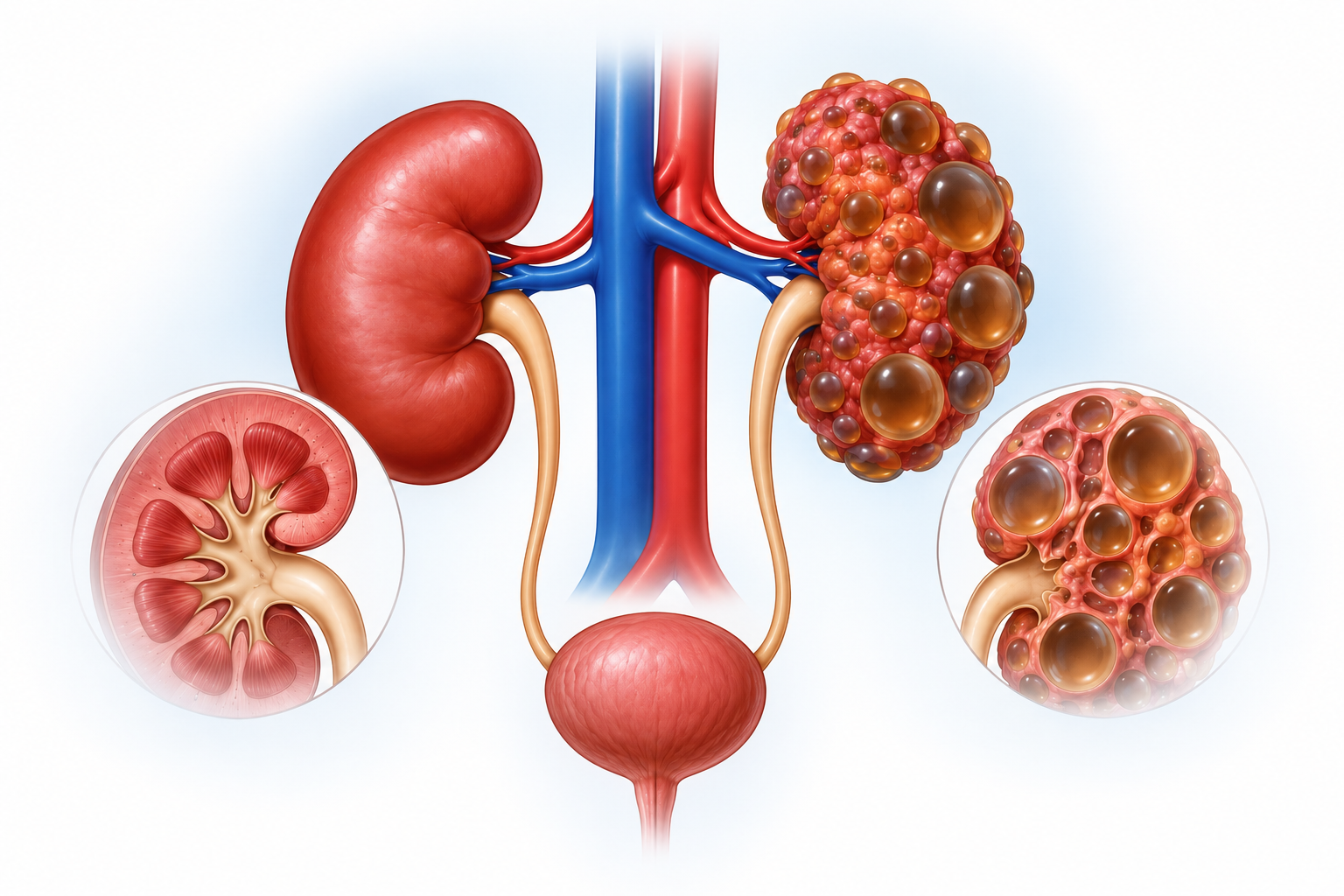






Not all kidney cysts are the same. Their appearance, structure, and potential impact on kidney health help determine whether monitoring or treatment is necessary.
The most common type, these thin-walled, fluid-filled cysts are typically benign and rarely require treatment.
These cysts may have thicker walls, internal divisions, or solid components. Additional imaging or monitoring may be needed to evaluate their characteristics.
An inherited condition that causes numerous cysts to develop in the kidneys. Over time, these cysts may enlarge the kidneys and affect their function.
Kidney cysts are often discovered during imaging tests performed for another medical concern. Your provider may recommend additional evaluation to determine the type of cyst and whether follow-up is needed.
Ultrasound uses sound waves to create images of the kidneys and can help distinguish simple fluid-filled cysts from more complex masses.
Detailed imaging can provide additional information about a cyst’s size, structure, and characteristics, particularly when a cyst appears complex.
Complex kidney cysts may be evaluated using the Bosniak classification system, which helps determine the need for monitoring or further treatment.
Most simple kidney cysts do not require treatment. When a cyst causes symptoms, affects kidney function, or has concerning features, your urologist may recommend additional care.
Cysts that do not require immediate treatment may be monitored with periodic imaging, depending on their characteristics.
For certain symptomatic simple cysts, fluid may be drained and a solution introduced to help reduce the likelihood of the cyst returning.
Surgery may be recommended for selected symptomatic cysts or complex cysts with concerning features, depending on the findings.